The Geodetic Survey: Conclusive Answers to Irrational Objections
A post-survey defense of the Koreshan Geodetic Survey at Naples, Florida, addressing critics who claimed the Rectilineator was inaccurate or deliberately inclined. The article demonstrates the ratio of concave curvature matched predictions at every eighth-mile interval, explains the reversal method that neutralizes mechanical inaccuracies, and shows how the two main objections contradict each other. Cites Harvey and Galileo as historical parallels of scientific truth prevailing over denial.
Extracted text
Editorial transcription, lightly normalized from the scan. Line-break hyphenation and unmistakable OCR errors have been repaired; the claims remain those of The Flaming Sword.
The Geodetic Survey.
Conclusive Answers to Irrational Objections and Arguments Against the Results Obtained by the Rectilineator. Obstinacy Manifested by the Chagrined Critics.
I learned, as my first great lesson in the inquiry into obscure fields of knowledge, never to accept the disbelief of great men or their accusations of imposture or of imbecility, as of any weight when opposed to the repeated observation of facts by other men admittedly sane and honest. The whole history of science shows us that whenever educated and scientific men of any age have denied the facts of other investigators on a priori grounds of absurdity, the deniers have always been wrong.—Prof. A. Russell Wallace, the Eminent Naturalist.
The Geodetic work at Naples, Fla., has been completed, and the facts thereby obtained have been published to the world. Many are rejoicing over the results; others are chagrined. In the stubborn resistance immediately manifested by a few who would have rejoiced had the evidences produced by the employment of the Rectilineator been favorable to the Copernican theory, we find history repeating itself.
When the telescope was invented and began to reveal the movement of satellites about the planets, the facts observed by Galileo and others were stubbornly denied by the astronomers of the Ptolemaic system; and for years Galileo succeeded in inducing but few to witness the phenomena through the telescope. One scientist who had more zeal, prejudice and jealousy than knowledge and wisdom, wrote a dissertation of the telescope, attempting to show how astigmatisms could be produced in the lenses and the lenses made to revolve in such a way as to give the appearance of the satellites revolving about the planet Jupiter. That man lived and died without ever having made a single astronomical observation by means of the telescope. What did he know about the telescope? The sequel proved that he knew nothing; yet he denied that the objects that were seen were possible to be seen.
Geodetic and Geometrical Ratio of Earth's Concavity.
The earth's concavity is considered as an absurdity, and the long line of demonstrations of the same, the mere result of deception and fraud. What do our critics know about the facts we have observed? Upon what reasonable ground can the evidences we present, be disputed by those who have never undertaken the lines of experimentation we have projected? The opposition to our work today is as unreasonable, absurd and idiotic as that manifested against the work of Harvey and Galileo.
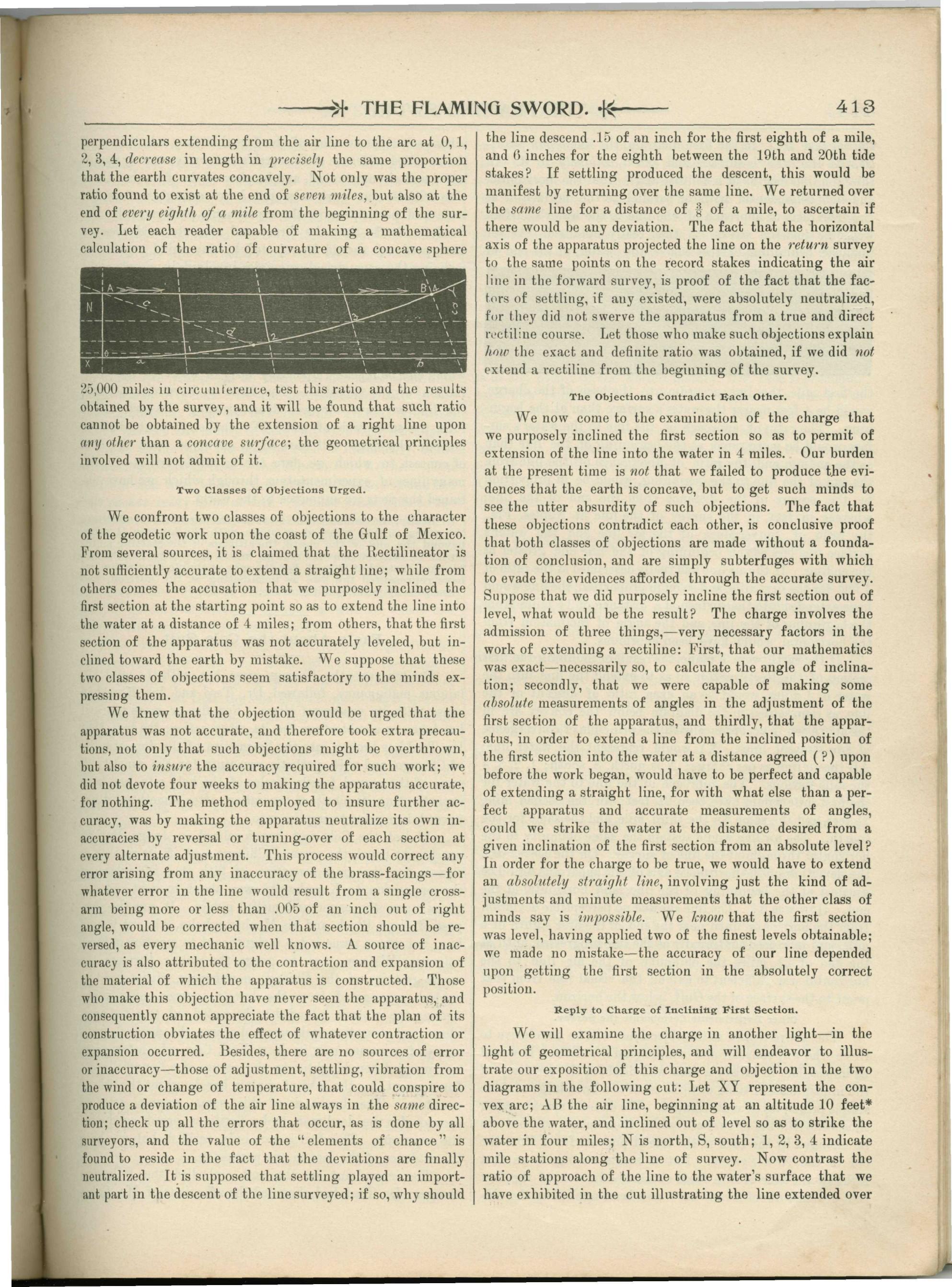
We have surveyed a line upon the Gulf coast of Florida. The measurements were such as to demonstrate conclusively the concave arc of the earth's curvature upon which the survey was made, and not only the direction of its curvature, but also its ratio. In this survey we found a definite ratio of approach of the earth's surface to meet the rectiline extended from an altitude of 10 feet above the water level; the line was extended into the water's surface at a distance of about 4 miles from the beginning of the survey. The ratio of the concave curvature was in proportion to the square of the distance; at the end of the first mile the distance between the air line and the water's surface was 8 inches less than at the beginning, because the earth in this distance had curvated upwards 8 inches; the second mile, about 2 feet and 8 inches; third mile, 6 feet, while at the end of the fourth mile the line extended into the Gulf.
Perpendiculars extending from the air line to the arc at 0, 1, 2, 3, 4, decrease in length in precisely the same proportion that the earth curvates concavely. Not only was the proper ratio found to exist at the end of seven miles, but also at the end of every eighth of a mile from the beginning of the survey. Let each reader capable of making a mathematical calculation of the ratio of curvature of a concave sphere 25,000 miles in circumference, test this ratio and the results obtained by the survey, and it will be found that such ratio cannot be obtained by the extension of a right line upon any other than a concave surface; the geometrical principles involved will not admit of it.
Two Classes of Objections Urged.
We confront two classes of objections to the character of the geodetic work upon the coast of the Gulf of Mexico. From several sources, it is claimed that the Rectilineator is not sufficiently accurate to extend a straight line; while from others comes the accusation that we purposely inclined the first section at the starting point so as to extend the line into the water at a distance of 4 miles; from others, that the first section of the apparatus was not accurately leveled, but inclined toward the earth by mistake. We suppose that these two classes of objections seem satisfactory to the minds expressing them.
We knew that the objection would be urged that the apparatus was not accurate, and therefore took extra precautions, not only that such objections might be overthrown, but also to insure the accuracy required for such work; we did not devote four weeks to making the apparatus accurate, for nothing. The method employed to insure further accuracy, was by making the apparatus neutralize its own inaccuracies by reversal or turning-over of each section at every alternate adjustment. This process would correct any error arising from any inaccuracy of the brass-facings—for whatever error in the line would result from a single cross-arm being more or less than .005 of an inch out of right angle, would be corrected when that section should be reversed, as every mechanic well knows.
A source of inaccuracy is also attributed to the contraction and expansion of the material of which the apparatus is constructed. Those who make this objection have never seen the apparatus, and consequently cannot appreciate the fact that the plan of its construction obviates the effect of whatever contraction or expansion occurred. Besides, there are no sources of error or inaccuracy—those of adjustment, settling, vibration from the wind or change of temperature, that could conspire to produce a deviation of the air line always in the same direction; check up all the errors that occur, as is done by all surveyors, and the value of the "elements of chance" is found to reside in the fact that the deviations are finally neutralized. It is supposed that settling played an important part in the descent of the line surveyed; if so, why should the line descend .15 of an inch for the first eighth of a mile, and 0 inches for the eighth between the 19th and 20th tide stakes? If settling produced the descent, this would be manifest by returning over the same line. We returned over the same line for a distance of ⅜ of a mile, to ascertain if there would be any deviation. The fact that the horizontal axis of the apparatus projected the line on the return survey to the same points on the record stakes indicating the air line in the forward survey, is proof of the fact that the factors of settling, if any existed, were absolutely neutralized, for they did not swerve the apparatus from a true and direct rectiline course.
The Objections Contradict Each Other.
We now come to the examination of the charge that we purposely inclined the first section so as to permit of extension of the line into the water in 4 miles. The fact that these objections contradict each other, is conclusive proof that both classes of objections are made without a foundation of conclusion, and are simply subterfuges with which to evade the evidences afforded through the accurate survey. Suppose that we did purposely incline the first section out of level, what would be the result? The charge involves the admission of three things—very necessary factors in the work of extending a rectiline: First, that our mathematics was exact—necessarily so, to calculate the angle of inclination; secondly, that we were capable of making some absolute measurements of angles in the adjustment of the first section of the apparatus, and thirdly, that the apparatus, in order to extend a line from the inclined position of the first section into the water at a distance agreed (?) upon before the work began, would have to be perfect and capable of extending a straight line, for with what else than a perfect apparatus and accurate measurements of angles, could we strike the water at the distance desired from a given inclination of the first section from an absolute level?
In order for the charge to be true, we would have to extend an absolutely straight line, involving just the kind of adjustments and minute measurements that the other class of minds say is impossible. We know that the first section was level, having applied two of the finest levels obtainable; we made no mistake—the accuracy of our line depended upon getting the first section in the absolutely correct position.
Reply to Charge of Inclining First Section.
We will examine the charge in another light—in the light of geometrical principles. Let XY represent the convex arc; AB the air line, beginning at an altitude 10 feet above the water, and inclined out of level so as to strike the water in four miles; N is north, S, south; 1, 2, 3, 4 indicate mile stations along the line of survey. Now contrast the ratio of approach of the line to the water's surface that we have exhibited in the cut illustrating the line extended over...
--
The source scans remain the record. This page preserves the periodical's claims without presenting its conclusions as independently established results.
Source:The Flaming Sword · Vol. 11, No. 6 · June 1897 · Physical PDF pp. 4–5
The Flaming Sword · Vol. 11, No. 6 · Jun 1897 · PDF pp. 4-5