The Salvator and Scientist: Koreshan Survey Premise, Astronomical Problems, and Telescopic Observations
A Koreshan article published in The Salvator and Scientist laying out the straight-line survey premise, proposing the Greatest Geodetic Experiment of Modern Times, challenging astronomers with unsolved problems, and reporting telescopic observations that restored vanished ships' hulls to view — including the Lake Michigan experiment and Parallax's Bedford Canal tests.
Extracted text
Editorial transcription, lightly normalized from the scan. Line-break hyphenation, spacing, capitalization, and unmistakable OCR errors have been repaired; the claims remain those of The Flaming Sword and The Salvator and Scientist.
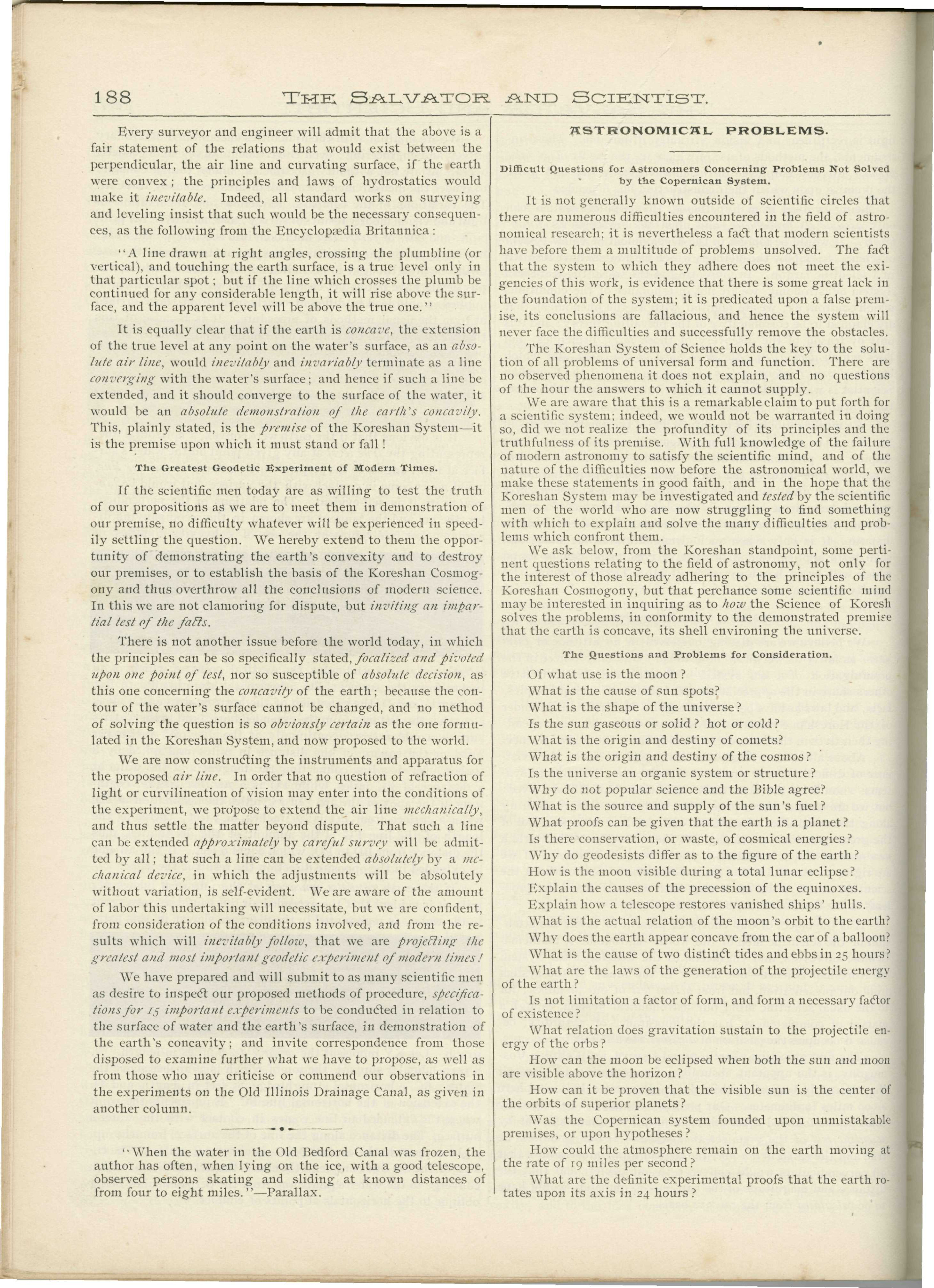
Every surveyor and engineer will admit that the above is a fair statement of the relations that would exist between the perpendicular, the air line and curvating surface, if the earth were convex; the principles and laws of hydrostatics would make it inevitable. Indeed, all standard works on surveying and leveling insist that such would be the necessary consequences, as the following from the Encyclopædia Britannica:
"A line drawn at right angles, crossing the plumbline (or vertical), and touching the earth surface, is a true level only in that particular spot; but if the line which crosses the plumb be continued for any considerable length, it will rise above the surface, and the apparent level will be above the true one."
It is equally clear that if the earth is concave, the extension of the true level at any point on the water's surface, as an absolute air line, would inevitably and invariably terminate as a line converging with the water's surface; and hence if such a line be extended, and it should converge to the surface of the water, it would be an absolute demonstration of the earth's concavity. This, plainly stated, is the premise of the Koreshan System—it is the premise upon which it must stand or fall!
The Greatest Geodetic Experiment of Modern Times.
If the scientific men today are as willing to test the truth of our propositions as we are to meet them in demonstration of our premise, no difficulty whatever will be experienced in speedily settling the question. We hereby extend to them the opportunity of demonstrating the earth's convexity and to destroy our premises, or to establish the basis of the Koreshan Cosmogony and thus overthrow all the conclusions of modern science. In this we are not clamoring for dispute, but inviting an impartial test of the facts.
There is not another issue before the world today, in which the principles can be so specifically stated, focalized and pivoted upon one point of test, nor so susceptible of absolute decision, as this one concerning the concavity of the earth; because the contour of the water's surface cannot be changed, and no method of solving the question is so obviously certain as the one formulated in the Koreshan System, and now proposed to the world.
We are now constructing the instruments and apparatus for the proposed air line. In order that no question of refraction of light or curvilineation of vision may enter into the conditions of the experiment, we propose to extend the air line mechanically, and thus settle the matter beyond dispute. That such a line can be extended approximately by careful survey will be admitted by all; that such a line can be extended absolutely by a mechanical device, in which the adjustments will be absolutely without variation, is self-evident. We are aware of the amount of labor this undertaking will necessitate, but we are confident, from consideration of the conditions involved, and from the results which will inevitably follow, that we are projecting the greatest and most important geodetic experiment of modern times!
We have prepared and will submit to as many scientific men as desire to inspect our proposed methods of procedure, specifications for several important experiments to be conducted in relation to the surface of water and the earth's surface, in demonstration of the earth's concavity; and invite correspondence from those disposed to examine further what we have to propose, as well as from those who may criticise or commend our observations in the experiments on the Old Illinois Drainage Canal, as given in another column.
"When the water in the Old Bedford Canal was frozen, the author has often, when lying on the ice, with a good telescope, observed persons skating and sliding at known distances of from four to eight miles."—Parallax.
Astronomical Problems.
Difficult Questions for Astronomers Concerning Problems Not Solved by the Copernican System.
It is not generally known outside of scientific circles that there are numerous difficulties encountered in the field of astronomical research; it is nevertheless a fact that modern scientists have before them a multitude of problems unsolved. The fact that the system to which they adhere does not meet the exigencies of this work, is evidence that there is some great lack in the foundation of the system; it is predicated upon a false premise, its conclusions are fallacious, and hence the system will never face the difficulties and successfully remove the obstacles.
The Koreshan System of Science holds the key to the solution of all problems of universal form and function. There are no observed phenomena it does not explain, and no questions of the hour the answers to which it cannot supply.
We are aware that this is a remarkable claim to put forth for a scientific system; indeed, we would not be warranted in doing so, did we not realize the profundity of its principles and the truthfulness of its premise. With full knowledge of the failure of modern astronomy to satisfy the scientific mind, and of the nature of the difficulties now before the astronomical world, we make these statements in good faith, and in the hope that the Koreshan System may be investigated and tested by the scientific men of the world who are now struggling to find something with which to explain and solve the many difficulties and problems which confront them.
We ask below, from the Koreshan standpoint, some pertinent questions relating to the field of astronomy, not only for the interest of those already adhering to the principles of the Koreshan Cosmogony, but that perchance some scientific mind maybe interested in inquiring as to how the Science of Koresh solves the problems, in conformity to the demonstrated premise that the earth is concave, its shell environing the universe.
#### The Questions and Problems for Consideration.
Of what use is the moon?
What is the cause of sun spots?
What is the shape of the universe?
Is the sun gaseous or solid? hot or cold?
What is the origin and destiny of comets?
What is the origin and destiny of the cosmos?
Is the universe an organic system or structure?
Why do not popular science and the Bible agree?
What is the source and supply of the sun's fuel?
What proofs can be given that the earth is a planet?
Is there conservation, or waste, of cosmical energies?
Why do geodesists differ as to the figure of the earth?
How is the moon visible during a total lunar eclipse?
Explain the causes of the precession of the equinoxes.
Explain how a telescope restores vanished ships' hulls.
What is the actual relation of the moon's orbit to the earth?
Why does the earth appear concave from the car of a balloon?
What is the cause of two distinct tides and ebbs in 25 hours?
What are the laws of the generation of the projectile energy of the earth?
Is not limitation a factor of form, and form a necessary factor of existence?
What relation does gravitation sustain to the projectile energy of the orbs?
How can the moon be eclipsed when both the sun and moon are visible above the horizon?
How can it be proven that the visible sun is the center of the orbits of superior planets?
Was the Copernican system founded upon unmistakable premises, or upon hypotheses?
How could the atmosphere remain on the earth moving at the rate of 19 miles per second?
What are the definite experimental proofs that the earth rotates upon its axis in 24 hours?
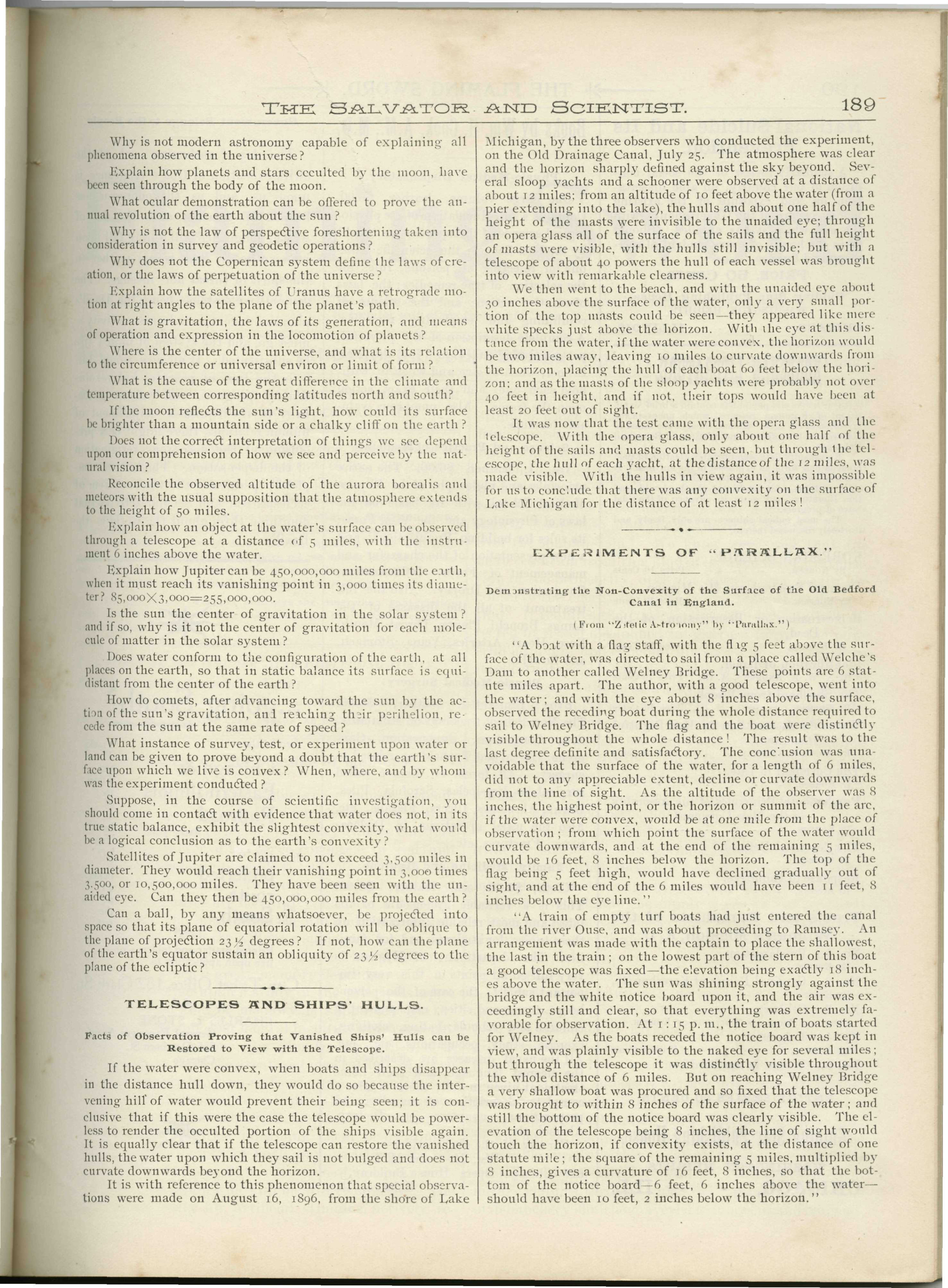
Why is not modern astronomy capable of explaining all phenomena observed in the universe? Explain how planets and stars occulted by the moon, have been seen through the body of the moon. What ocular demonstration can be offered to prove the annual revolution of the earth about the sun? Why is not the law of perspective foreshortening taken into consideration in survey and geodetic operations? Why does not the Copernican system define the laws of creation, or the laws of perpetuation of the universe? Explain how the satellites of Uranus have a retrograde motion at right angles to the plane of the planet's path. What is gravitation, the laws of its generation, and means of operation and expression in the locomotion of planets? Where is the center of the universe, and what is its relation to the circumference or universal environ or limit of form? What is the cause of the great difference in the climate and temperature between corresponding latitudes north and south? If the moon reflects the sun's light, how could its surface be brighter than a mountain side or a chalky cliff on the earth? Does not the correct interpretation of things we see depend upon our comprehension of how we see and perceive by the natural vision? Reconcile the observed altitude of the aurora borealis and meteors with the usual supposition that the atmosphere extends to the height of 50 miles. Explain how an object at the water's surface can be observed through a telescope at a distance of 5 miles, with the instrument 6 inches above the water. Explain how Jupiter can be 450,000,000 miles from the earth, when it must reach its vanishing point in 3,000 times its diameter? 85,000×3,000=255,000,000. Is the sun the center of gravitation in the solar system? and if so, why is it not the center of gravitation for each molecule of matter in the solar system? Does water conform to the configuration of the earth, at all places on the earth, so that in static balance its surface is equidistant from the center of the earth? How do comets, after advancing toward the sun by the action of the sun's gravitation, and reaching their perihelion, recede from the sun at the same rate of speed? What instance of survey, test, or experiment upon water or land can be given to prove beyond a doubt that the earth's surface upon which we live is convex? When, where, and by whom was the experiment conducted? Suppose, in the course of scientific investigation, you should come in contact with evidence that water does not, in its true static balance, exhibit the slightest convexity, what would be a logical conclusion as to the earth's convexity? Satellites of Jupiter are claimed to not exceed 3,500 miles in diameter. They would reach their vanishing point in 3,000 times 3,500, or 10,500,000 miles. They have been seen with the unaided eye. Can they then be 450,000,000 miles from the earth? Can a ball, by any means whatsoever, be projected into space so that its plane of equatorial rotation will be oblique to the plane of projection 23½ degrees? If not, how can the plane of the earth's equator sustain an obliquity of 23½ degrees to the plane of the ecliptic?
Telescopes and Ships' Hulls.
Facts of Observation Proving that Vanished Ships' Hulls can be Restored to View with the Telescope.
If the water were convex, when boats and ships disappear in the distance hull down, they would do so because the intervening hill of water would prevent their being seen; it is conclusive that if this were the case the telescope would be powerless to render the occulted portion of the ships visible again. It is equally clear that if the telescope can restore the vanished hulls, the water upon which they sail is not bulged and does not curvate downwards beyond the horizon.
It is with reference to this phenomenon that special observations were made on August 16, 1896, from the shore of Lake Michigan, by the three observers who conducted the experiment, on the Old Drainage Canal, July 25. The atmosphere was clear and the horizon sharply defined against the sky beyond. Several sloop yachts and a schooner were observed at a distance of about 12 miles; from an altitude of 10 feet above the water (from a pier extending into the lake), the hulls and about one half of the height of the masts were invisible to the unaided eye; through an opera glass all of the surface of the sails and the full height of masts were visible, with the hulls still invisible; but with a telescope of about 40 powers the hull of each vessel was brought into view with remarkable clearness.
We then went to the beach, and with the unaided eye about 30 inches above the surface of the water, only a very small portion of the top masts could be seen—they appeared like mere white specks just above the horizon. With the eye at this distance from the water, if the water were convex, the horizon would be two miles away, leaving 10 miles to curvate downwards from the horizon, placing the hull of each boat 60 feet below the horizon: and as the masts of the sloop yachts were probably not over 40 feet in height, and if not, their tops would have been at least 20 feet out of sight.
It was now that the test came with the opera glass and the telescope. With the opera glass, only about one half of the height of the sails and masts could be seen, but through the telescope, the hull of each yacht, at the distance of the 12 miles, was made visible. With the hulls in view again, it was impossible for us to conclude, that there was any convexity on the surface of Lake Michigan for the distance of at least 12 miles!
#### Experiments of Parallax,
Demonstrating the Non-Convexity of the Surface of the Old Bedford Canal in England.
(From "Zetetic Astronomy" by "Parallax.")
"A boat with a flag staff, with the flag 5 feet above the surface of the water, was directed to sail from a place called Welche's Dam to another called Welney Bridge. These points are 6 statute miles apart. The author, with a good telescope, went into the water; and with the eye about 8 inches above the surface, observed the receding boat during the whole distance required to sail to Welney Bridge. The flag and the boat were distinctly visible throughout the whole distance! The result was to the last degree definite and satisfactory. The conclusion was unavoidable that the surface of the water, for a length of 6 miles, did not to any appreciable extent, decline or curvate downwards from the line of sight. As the altitude of the observer was 8 inches, the highest point, or the horizon or summit of the arc, if the water were convex, would be at one mile from the place of observation; from which point the surface of the water would curvate downwards, and at the end of the remaining 5 miles, would be 16 feet, 8 inches below the horizon. The top of the flag being 5 feet high, would have declined gradually out of sight, and at the end of the 6 miles would have been 11 feet, 8 inches below the eye line.
"A train of empty turf boats had just entered the canal from the river Ouse, and was about proceeding to Ramsay. An arrangement was made with the captain to place the shallowest, the last in the train; on the lowest part of the stern of this boat a good telescope was fixed—the elevation being exactly 18 inches above the water. The sun was shining strongly against the bridge and the white notice board upon it, and the air was exceedingly still and clear, so that everything was extremely favorable for observation. At 1:15 p.m., the train of boats started for Welney. As the boats receded the notice board was kept in view, and was plainly visible to the naked eye for several miles; but through the telescope it was distinctly visible throughout the whole distance of 6 miles. But on reaching Welney Bridge a very shallow boat was procured and so fixed that the telescope was brought to within 8 inches of the surface of the water; and still the bottom of the notice board was clearly visible. The elevation of the telescope being 8 inches, the line of sight would touch the horizon, if convexity exists, at the distance of one statute mile; the square of the remaining 5 miles, multiplied by 8 inches, gives a curvature of 16 feet, 8 inches, so that the bottom of the notice board—6 feet, 6 inches above the water—should have been 10 feet, 2 inches below the horizon."
--
The source scans remain the record. This page preserves the periodical's claims without presenting its conclusions as independently established results.
Source citation:The Flaming Sword (reprinted from The Salvator and Scientist) · Vol. 10, No. 8 · Aug 1896 · PDF pp. 20–21
The Flaming Sword · Vol. 10, No. 8 · Aug 1896 · PDF pp. 20-21