Extracted text
Source-led transcription, lightly normalized from the cited page scans; historical claims remain attributed to The Flaming Sword.
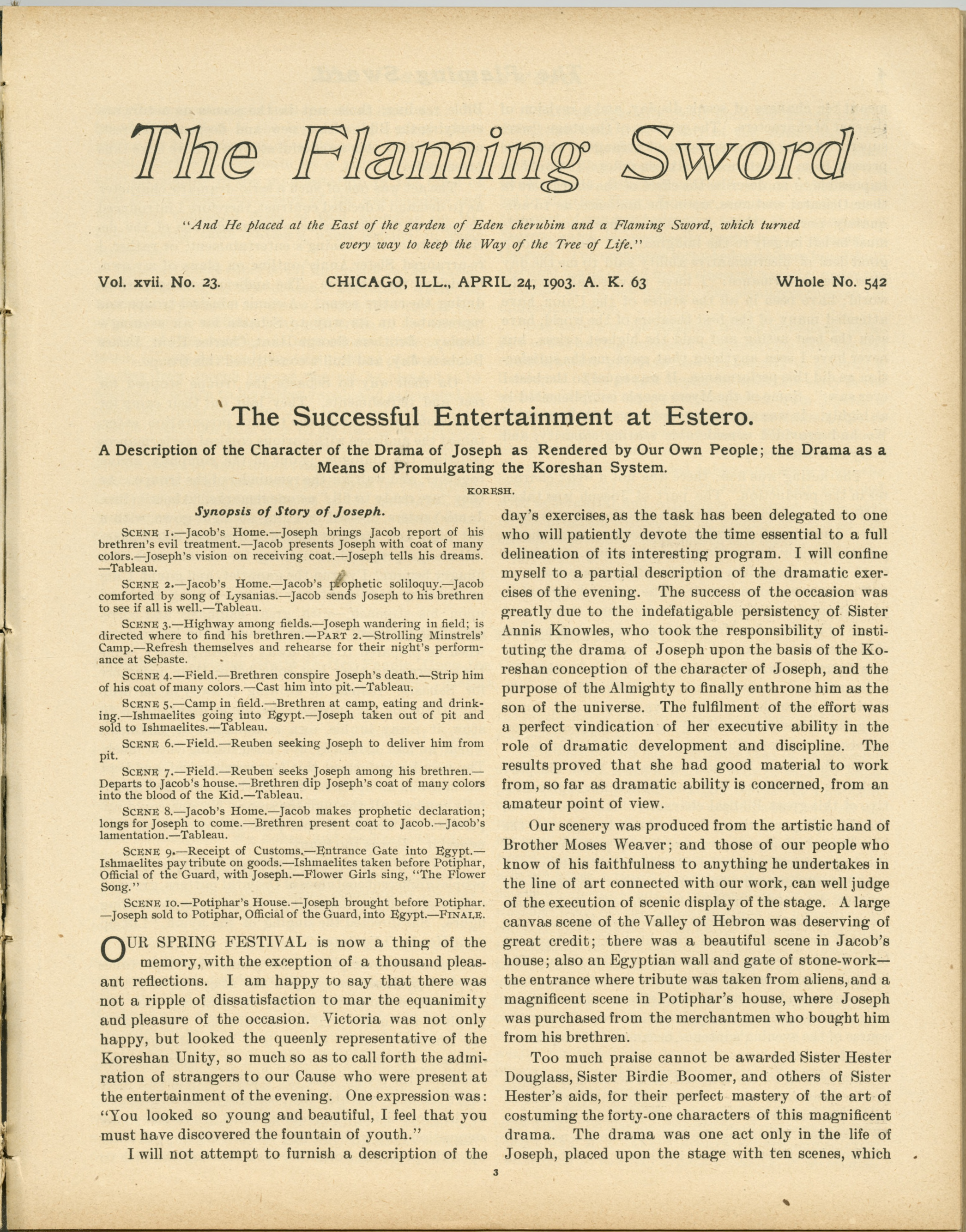
A Description of the Character of the Drama of Joseph as Rendered by Our Own People; the Drama as a Means of Promulgating the Koreshan System.
Synopsis of Story of Joseph.
- Scene 1.—Jacob’s Home.—Joseph brings Jacob report of his brethren’s evil treatment.—Jacob presents Joseph with coat of many colors.—Joseph’s vision on receiving coat.—Joseph tells his dreams.—Tableau.
- Scene 2.—Jacob’s Home.—Jacob’s prophetic soliloquy.—Jacob comforted by song of Lysanias.—Jacob sends Joseph to his brethren to see if all is well.—Tableau.
- Scene 3.—Highway among fields.—Joseph wandering in field; is directed where to find his brethren.—Part 2.—Strolling Minstrels’ Camp.—Refresh themselves and rehearse for their night’s performance at Sebaste.
- Scene 4.—Field.—Brethren conspire Joseph’s death.—Strip him of his coat of many colors.—Cast him into pit.—Tableau.
- Scene 5.—Camp in field.—Brethren at camp, eating and drinking.—Ishmaelites going into Egypt.—Joseph taken out of pit and sold to Ishmaelites.—Tableau.
- Scene 6.—Field.—Reuben seeking Joseph to deliver him from pit.
- Scene 7.—Field.—Reuben seeks Joseph among his brethren.— Departs to Jacob’s house.—Brethren dip Joseph’s coat of many colors into the blood of the Kid.—Tableau.
- Scene 8.— Jacob’s Home.—Jacob makes prophetic declaration; longs for Joseph to come.—Brethren present coat to Jacob.—Jacob’s lamentation.—Tableau.
- Scene 9.— Receipt of Customs.— Entrance Gate into Egypt.— Ishmaelites pay tribute on goods.—Ishmaelites taken before Potiphar, Official of the Guard, with Joseph.—Flower Girls sing, “The Flower Song.”
- Scene 10.—Potiphar’s House.—Joseph brought before Potiphar.—Joseph sold to Potiphar, Official of the Guard, into Egypt.—Finale.
OUR SPRING FESTIVAL is now a thing of the memory, with the exception of a thousand pleasant reflections. I am happy to say that there was not a ripple of dissatisfaction to mar the equanimity and pleasure of the occasion. Victoria was not only happy, but looked the queenly representative of the Koreshan Unity, so much so as to call forth the admiration of strangers to our Cause who were present at the entertainment of the evening. One expression was: “ You looked so young and beautiful, I feel that you must have discovered the fountain of youth.”
I will not attempt to furnish a description of the day’s exercises, as the task has been delegated to one who will patiently devote the time essential to a full delineation of its interesting program. I will confine myself to a partial description of the dramatic exercises of the evening. The success of the occasion was greatly due to the indefatigable persistency of Sister Annis Knowles, who took the responsibility of instituting the drama of Joseph upon the basis of the Koreshan conception of the character of Joseph, and the purpose of the Almighty to finally enthrone him as the son of the universe. The fulfilment of the effort was a perfect vindication of her executive ability in the role of dramatic development and discipline. The results proved that she had good material to work from, so far as dramatic ability is concerned, from an amateur point of view.
Our scenery was produced from the artistic hand of Brother Moses Weaver; and those of our people who know of his faithfulness to anything he undertakes in the line of art connected with our work, can well judge of the execution of scenic display of the stage. A large canvas scene of the Valley of Hebron was deserving of great credit; there was a beautiful scene in Jacob’s house; also an Egyptian wall and gate of stone-work— the entrance where tribute was taken from aliens, and a magnificent scene in Potiphar’s house, where Joseph was purchased from the merchantmen who bought him from his brethren.
Too much praise cannot be awarded Sister Hester Douglass, Sister Birdie Boomer, and others of Sister Hester’s aids, for their perfect mastery of the art of costuming the forty-one characters of this magnificent drama. The drama was one act only in the life of Joseph, placed upon the stage with ten scenes, which meant ten changes of scenic display, and a revision of the cast of characters. The settings of the stage “ were superb,” to use the expression of strangers who were present from a distance of sixteen miles. It would be impossible to so describe the effect of the characters in their Oriental costumes, upon the audience, as to adequately portray their exquisite appearance. This must be left largely to the imagination. One man of a good deal of discriminative ability said to me the day after the performance: “ I have traveled all over the world; have been in all the states of the Union, have attended many of the best theaters of the world, have seen the best acting and paid the highest prices, but never have I seen anything that gave me the satisfaction as did this performance. It was equal to the best I ever saw.” Some of the Myers people complimented it as highly. It was an eye-opener for everybody present. We had provided considerable seating capacity, and every seat was occupied.
The acting was fine; there was not a weak character in the production. The part of Joseph was taken by Sister Marguerite Borden; the selection for this character demonstrated that the choice was not a disappointment, for her acting was charming and called forth great encomium from the strangers present, as well as from our own people. The song of Lysanias, accompanied by Salome, (words by Sister Annis, and music by Brother Jay Morgan), was executed with great skill, the talent of a real artist. Catharine McCready was instructed in its execution by Victoria Gratia, who is deserving of praise for her skill in bringing out the merits of a wonderful voice. Eva, Mamie, and Lovell sang the flower song, making a graceful appearance on the stage, and executing their work in artistic style.
Brother Ross Wallace, as Jacob, took his part with true professional style, and was a fine representative of this great Biblical character. His execution of the difficult part, where the brethren brought in the bloody coat of Joseph, was excellently performed; and the hypocritical acting of Brother Rollin Gray was equally well executed. It is impossible to delineate the various characters in this play; the only disappointment, was in the character of the “ certain man” who directed Joseph to Dotham, when his brethren departed from Shechem where Joseph had sought them. The “ certain man” lost his “ lines” and had to go out on impromptu and extemporaneous efforts. The audience may not have detected any deviation from the regular course of the evening’s intents, because of his departure from the role.
The setting of the first act in a series of dramatic productions from the stories of the Bible, affords us great pleasure from the perceptible effects upon our own people. In placing the Scriptures in the new light of Koreshan Science, it has awakened an interest in Bible reading; those not in the scenes as actors are studying the Bible with a new and deepened interest, and especially this wonderful story which we have thus presented.
The act was one of such a serio-dramatic character as to demand a decided contrast, therefore I introduced the part of the third scene, which made one of the decided hits of the evening’s entertainment; or rather, I re-arranged Sister Annis’ outline on plans of my own, furnishing the dialogue. The audience was uproarious during the entire scene. A comic minstrel troupe was represented on its way to Sebaste for an evening’s display. Brothers George Hunt, Charles Hunt, James Bubbett, Jay, and Rollin constituted this troupe.
On their way to Sebaste, the troupe stopped for rest and refreshments. They laid out their camp for provisions, and, during the time of preparation, entertained the audience with various comical performances befitting the dialogue. Four of the company arrive together, and wait for the remainder of the troupe. As they “ are ready to fill,” as one remarks, “ Abner” (Bro. James) enters, dressed in a long straight gown, with a hat high and straight like a stovepipe, ejaculating: “ Have ye prepared something for the stomach of a hungry beggar? I’ve run the gauntlet, and gaunt I am as a beanpole without any beans,—placing his hand upon his stomach,—with great emphasis and corresponding grimace. “ Aaron” brought the house down when he prepared to stow away the commissary, while the singers sang their last song before their departure for Sebaste. Instead of stowing it away in the ordinary traps for the occasion, he made great haste to stow it away in his own commissary department, which he had evidently not filled during their lunch. The way he performed this feat was comical, and kept the house in an uproar. The brothers were all wonderfully comical, all through the scene. No one could appreciate the acting of this part without having witnessed it. It was too funny.
The final tableau was a brilliant affair, with forty people in different costumes of Oriental pattern, grouped artistically on the stage, Victoria Gratia as the leading figure. She directed the singing of the hymn, “ Lift up your Heads, O Ye Gates.”
I have contemplated for years the importance of placing Koreshanity upon the stage, as a fitting means of reaching the public, maintaining that the pulpit of the future would be the drama. The ritual of the Roman Catholic church is a faint attempt and approach to the true conception of entertaining the masses of the people with the truths of religion. This effort has demonstrated the possibility of an execution of the proposition. It required some one to accept the suggestion and, without any further urgency, to enter upon the practical work of consummating the wish to have the suggestion put into practical execution. We feel that this effort is the beginning of a great undertaking in the direction of a dramatic power in the world, which will terminate as a great climax in the brilliant display of the manifestation of the Sons of God in the scenic conclusion of the one hundred and forty-four thousand Sons of God, standing on Mt. Zion, having their Father’s name written in their foreheads.
No descriptive effort could do justice to the character of the acting of this drama. The scene where the brethren are about to throw Joseph into the pit was so wonderfully realistic, that one person of the cracker variety of this country, in true cracker dialect, ejaculated: “Them do shuah want to git shut of that boy.” As they drew Joseph toward the pit, he pleaded to be allowed to return to his father Jacob, and attempted to resist their determination. Just before reaching the pit, Joseph makes one final plea to his God for deliverance. At this point in his plea for succor, while kneeling, Joseph seems to have found relief; for his plea is accompanied with a sudden calm, portrayed in the appeal. It seemed a willing submission to the inevitable, or a composure born of his faith in his God. Sister Marguerite acted her part with great credit.
I have not specially dwelt upon her acting for any detraction from that of any of the other characters, but more particularly because it was the center around which the play revolved. Sister Birdie made an exquisite Dinah, daughter of Jacob. Our orchestra was led by Brother Harry Boomer, our new acquisition to this part of our great pleasure, here in the wilderness of Estero, which is practically beginning to blossom as the rose. The orchestra furnished some very beautifully executed music of the most classical variety, under the direction of our new leader. The strangers enjoyed the music immensely.
One feature of the occasion fitting of remark, is the fact of our having prepared, in connection with the free entertainment given to the community in general, a free lunch. The people began to assemble early in the evening; and as many were expected from Myers, a distance of sixteen miles, it was deemed admissible to give the strangers an evening lunch. We erected a long line of stalls for their teams, out in a distant part of the grounds, and provided tables and seats upon the lawn, where our guests were sumptuously provided with substantial and attractive delicacies. This part of the program seemed to be greatly enjoyed by the strangers present. Thus endeth this lesson.
- --
Source: The Flaming Sword, Vol. 17, No. 23 (24 Apr 1903), PDF pp. 1–3.
The Flaming Sword · Vol. 17, No. 23 · 24 Apr 1903 · PDF pp. 1-3