Extracted text
Editorial transcription, lightly normalized from the scan. Line-break hyphenation and unmistakable OCR errors have been repaired; the claims remain those of The Flaming Sword.
Editorial Discussions and Miscellany.
#### Baltimore American Controversy.
An Eastern Man Blunders While Endeavoring to Evade the Direct Evidences of the Earth's Concavity.
The fundamental error on which Koreshanity, with its vagrant religious and pseudo-scientific beliefs, is based is the assumption that our earth is concave, in direct opposition to all established facts of the Copernican system now universally taught, viz., that our earth is convex, and in shape that of a sphere, which is flattened at the poles, and we living on the outside of this sphere. To substantiate this false assumption on the part of the Koreshans, one of its leading disciples, who styles himself Professor U. G. Morrow, has conducted several elaborate experiments which, in their minds, they claim as scientific. And the conclusions they have arrived at from these experiments have had the bad effect of leading them still further from the truth.
The experiment of projecting an "air line" by means of a clumsy contrivance, that they call a "rectilineator," during May, 1897, on the coast of Florida, has been supplemented by a telescopic experiment on Lake Michigan, August 27, 1899, under the supervision of the aforesaid Prof. U. G. Morrow.
A brief outline of this experiment is that at an elevation of 11 feet above the water level, a mounted telescope of three inches aperture was located, and a lighthouse eight miles off was viewed. At the base or water level of the lighthouse a target three feet broad and six feet long was placed. The rate of convexity for four miles (or half the distance) would be about 11 feet, and their conclusion is that the target would be hid from view by this existing bulge. From a pamphlet published by the Koreshans, one might be led to the belief that they had really made out a good case, but this is not so.
—Edward A. Osse, Baltimore American.
The editor replies:
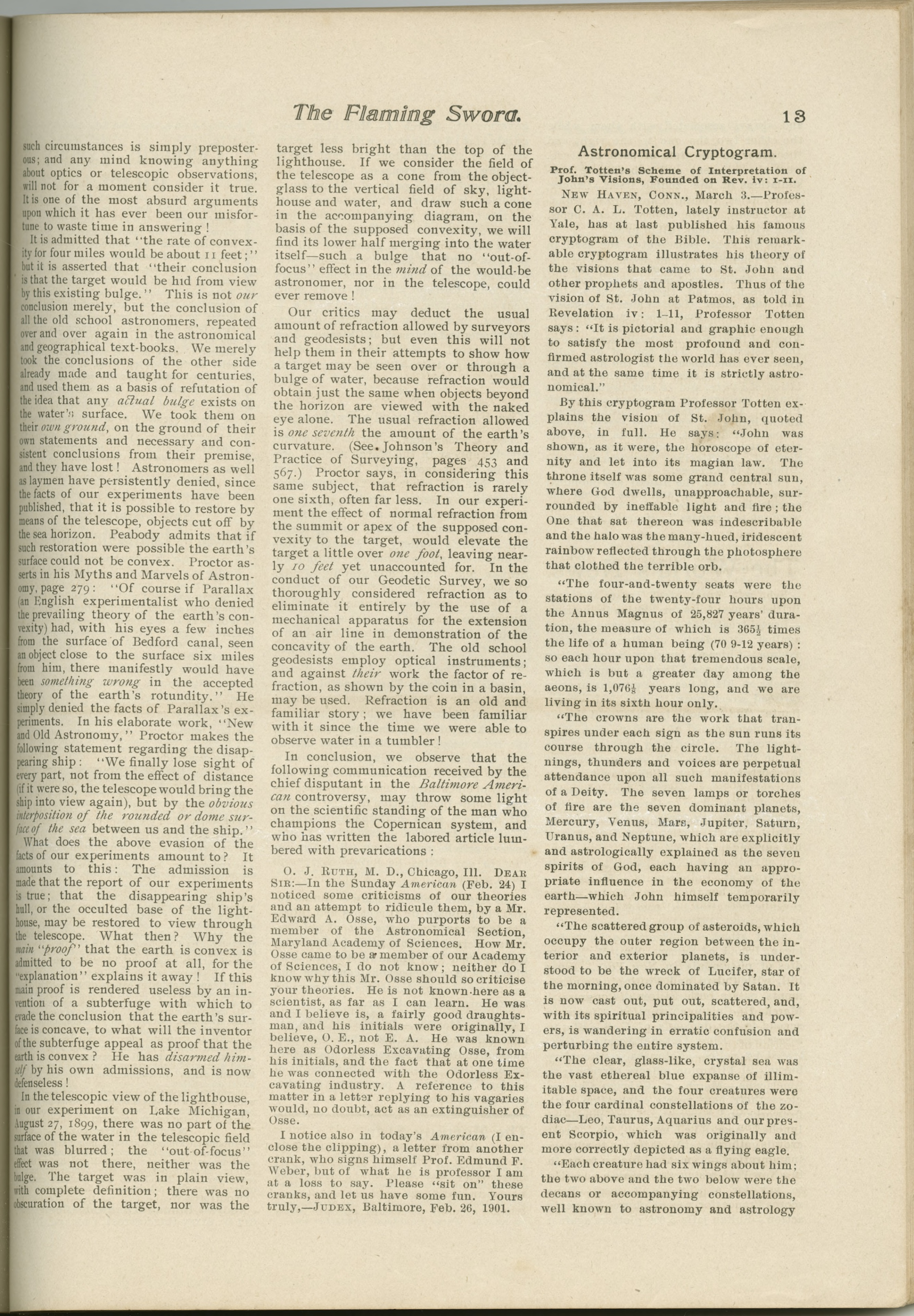
The distortion in the diagram by Prof. Morrow is at once apparent, when he represents our earth as having one mile diameter instead of 7,916 miles (mean diameter). The diagram drawn to a scale of 1–10,000 actual size, the bulge in four feet 2.6 inches (or 8 miles) amounts to a hair's breadth, or 13–1000 of an inch for 11 feet.
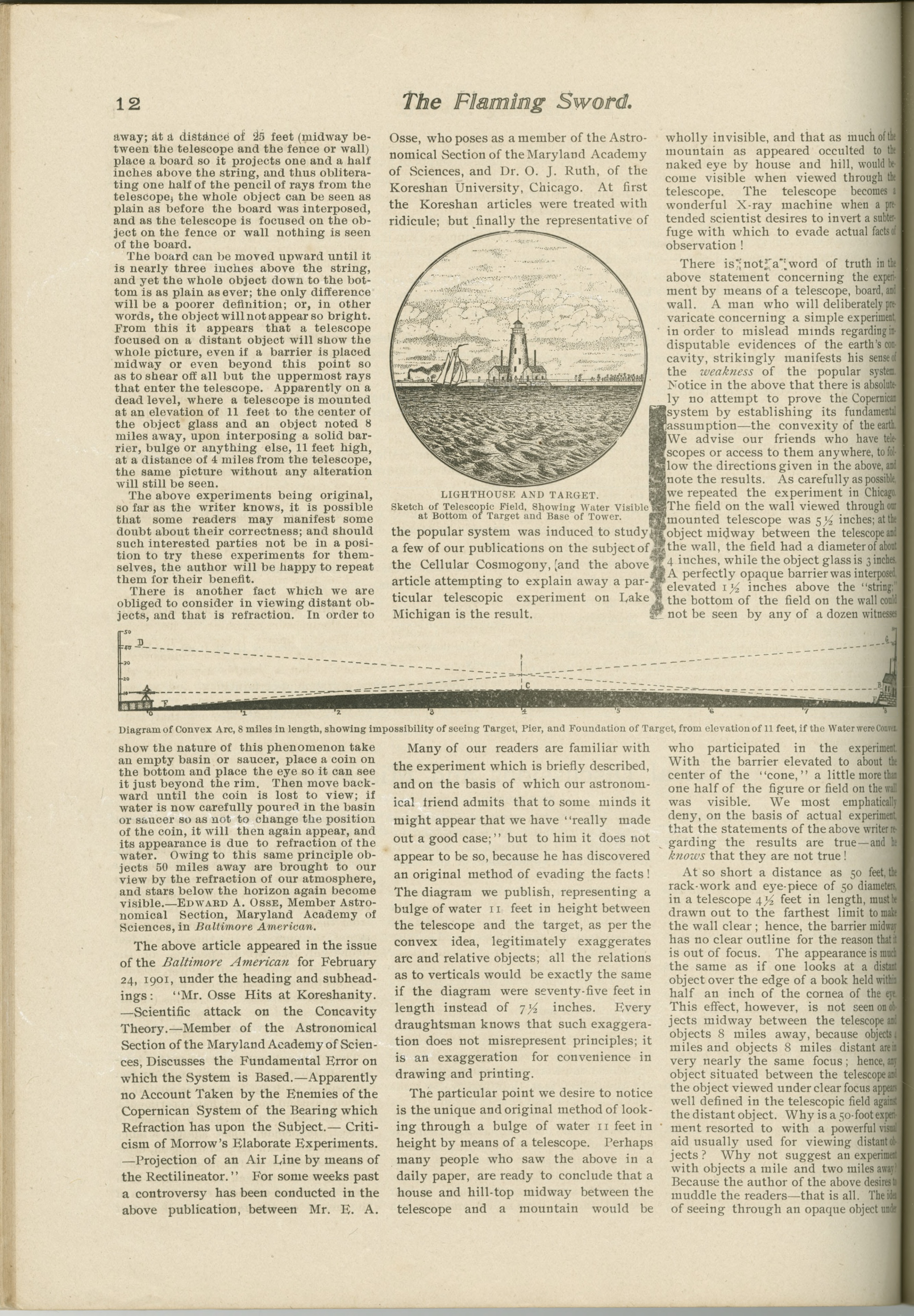
Another misrepresentation is the manner of representing the view through the telescope as a single line, whereas it should be a cylinder, or, more correctly, a cone of rays of lines. This is evident from the picture of the lighthouse and target. Taking the lighthouse as 50 feet in height, the whole picture, or the telescopic field, would be about 200 feet, and 200 feet at a distance of 8 miles would equal a circumference of 50½ miles (about) or 17 minutes of arc. The telescope used, therefore, had a visual angle of about 17 minutes of arc.
The following experiments with a telescope of three inch aperture and four feet six inches in length, which is similar to the one used in the Koreshan experiments, can be readily verified. At a distance of 50 feet, view some object against a fence or wall, and mark the whole field, especially the bottom of the field; then attach a string to the bottom of the three-inch object glass and extend it to the bottom of the object on the fence or wall 50 feet away; fit a distance of his feet (midway between the telescope and the fence or wall) place a board so it projects one and a half inches above the string, and thus obliterating one half of the pencil of rays from the telescope) the whole object can be seen as plain as before the board was interposed, and as the telescope is focused on the object on the fence or wall nothing is seen of the board.
The board can be moved upward until it is nearly three inches above the string, and yet the whole object down to the bottom is as plain as ever; the only difference will be a poorer definition; or, in other words, the object will not appear so bright.
From this it appears that a telescope focused on a distant object will show the whole picture, even if a barrier is placed midway or even beyond this point so as to shear off all but the uppermost rays that enter the telescope. Apparently on a dead level, where a telescope is mounted at an elevation of 11 feet to the center of the object glass and an object noted 8 miles away, upon interposing a solid barrier, bulge or anything else, 11 feet high, at a distance of 4 miles from the telescope, the same picture without any alteration will still be seen.
The above experiments being original, so far as the writer knows, it is possible that some readers may manifest some doubt about their correctness; and should such interested parties not be in a position to try these experiments for themselves, the author will be happy to repeat them for their benefit.
There is another fact which we are obliged to consider in viewing distant objects, and that is refraction. In order to make this as plain as possible, let us suppose that the telescope is pointed to the object in the water, and that the lens is half under the water and half above. Of course we could see the object plainly through the water. This would apply to the refraction of light in viewing through the water and the air.
Now, if we should take the telescope and turn it on a wall and place a board on a level with the telescope and board of proper thickness, the result would be the same; because the refraction of light where it enters a rare or dense medium is not more marked in one case than the other, providing the conditions are the same. This is a fact known and understood by persons of ordinary intelligence.
Referring to the lighthouse and target: In this case, the telescope being 11 feet above the water level, the line of the telescope's center to the top of the lighthouse would be an air line, and the target would be visible at the base of the lighthouse, without the least obstruction from any bulge of water or anything else, as the above experiments conclusively prove.
Osse, who poses as a member of the Astronomical Section of the Maryland Academy of Sciences, and with the pseudo-scientific pretensions that characterize many of his ilk, wrote a tirade against the Koreshan experiments and conclusions, and sought to nullify the force of these experiments by introducing certain evasions and subterfuges, reflecting the usual misrepresentations of those who oppose the facts of observation with the theories of the old astronomy. At first the Koreshan articles were treated with ridicule; but finally the representative of the popular system was induced to study a few of our publications on the subject of the Cellular Cosmogony, [and the above article attempting to explain away a particular telescopic experiment on Lake Michigan is the result.]
Lighthouse and Target. Sketch of Telescopic Field, Showing Water Visible at Bottom of Target and Base of Tower.
There is not a word of truth in the above statement concerning the experiment by means of a telescope, board, and wall. A man who will deliberately prevaricate concerning a simple experiment in order to mislead minds regarding indisputable evidences of the earth's concavity, strikingly manifests his sense of the weakness of the popular system. Notice in the above that there is absolutely no attempt to prove the Copernican system by establishing its fundamental assumption—the convexity of the earth.
We advise our friends who have telescopes or access to them anywhere, to follow the directions given in the above, and note the results. As carefully as possible, we repeated the experiment in Chicago. The field on the wall viewed through our mounted telescope was 5¼ inches; at the object midway between the telescope and the wall, the field had a diameter of about 4¼ inches, while the object glass is 3 inches. A perfectly opaque barrier was interposed, elevated 1½ inches above the "string;" the bottom of the field on the wall could not be seen by any of a dozen witnesses; wholly invisible, and that as much of the mountain as appeared occulted to the naked eye by house and hill, would become visible when viewed through the telescope. The telescope becomes a wonderful X-ray machine when a pretended scientist desires to invent a subterfuge with which to evade actual facts of observation!
It is admitted that "the rate of convexity for four miles would be about 11 feet;" but it is asserted that "their conclusion is that the target would be hid from view by this existing bulge." This is not our conclusion merely, but the conclusion of all the old school astronomers, repeated over and over again in the astronomical and geographical text-books. We merely took the conclusions of the other side already made and taught for centuries, and used them as a basis of refutation of the idea that any actual bulge exists on the water's surface. We took them on their own ground, on the ground of their own statements and necessary and consistent conclusions from their premise, and simply denied the facts of Parallax's experiments. In his elaborate work, "New and Old Astronomy," Proctor makes the following statement regarding the disappearing ship: "We finally lose sight of every part, not from the effect of distance (if it were so, the telescope would bring the ship into view again), but by the obvious interposition of the rounded or dome surface of the sea between us and the ship."
What does the above evasion of the facts of our experiments amount to? It amounts to this: The admission is made that the report of our experiments is true; that the disappearing ship's hull, or the occulted base of the lighthouse, may be restored to view through the telescope. What then? Why the main "proof" that the earth is convex is admitted to be no proof at all, for the "explanation" explains it away! If this main proof is rendered useless by an invention of a subterfuge with which to evade the conclusion that the earth's surface is concave, to what will the inventor of the subterfuge appeal as proof that the earth is convex? He has disarmed himself by his own admissions, and is now defenseless!
In the telescopic view of the lighthouse, in our experiment on Lake Michigan, August 27, 1899, there was no part of the surface of the water in the telescopic field that was blurred; but, on the contrary, the surface of the water was visible around the base of the lighthouse and the target. The lighthouse and target were sharply defined. Hence no blurring, merging, or refraction was necessary to bring the target into view. Moreover, the lower part of the target was as bright as the top of the lighthouse.
If we consider the field of the telescope as a cone from the object-glass to the vertical field of sky, lighthouse and water, and draws such a cone in the accompanying diagram, on the basis of the supposed convexity, we will find its lower half merging into the water itself—such a bulge that no "out-of-focus" effect in the mind of the would-be astronomer, nor in the telescope, could ever remove!
Our critics may deduct the usual amount of refraction allowed by surveyors and geodesists; but even this will not help them in their attempts to show how a target may be seen over or through a bulge of water, because refraction would obtain just the same when objects beyond the horizon are viewed with the naked eye alone. The usual refraction allowed is one seventh the amount of the earth's curvature. (See Johnson's Theory and Practice of Surveying.) We have been familiar with this story; we have been familiar with it since the time we were able to observe water in a tumbler!
In conclusion, we observe that the following communication received by the chief disputant in the Baltimore American controversy, may throw some light on the scientific standing of the man who champions the Copernican system, and who has written the labored article lumbered with prevarications:
O. J. Ruth, M. D., Chicago, Ill. Dear Sir:—In the Sunday American (Feb. 24) I noticed some criticisms of our theories and an attempt to ridicule them, by a Mr. Edward A. Osse, who purports to be a member of the Astronomical Section, Maryland Academy of Sciences. How Mr. Osse came to be a member of our Academy of Sciences, I do not know; neither do I know why this Mr. Osse should so criticise your theories. He is not known here as a scientist, as far as I can learn. He was and I believe is, a fairly good draftsman, and his initials were originally, I believe, O. E., not E. A. He was known here as Odorless Excavating Osse, from his initials, and the fact that at one time he was connected with the Odorless Excavating industry. A reference to this matter in a letter replying to his vagaries would, no doubt, act as an extinguisher of Osse.
—A. J. S.
- --
The source scans remain the record. This page preserves the periodical's claims without presenting its conclusions as independently established results.
Source: The Flaming Sword · Vol. 15, No. 16 · March 8, 1901 · Physical PDF pp. 11–13
The Flaming Sword · Vol. 15, No. 16 · Mar 8, 1901 · PDF pp. 11-13