Extracted text
Editorial transcription lightly normalized from the cited scan; historical claims below are those of The Flaming Sword and are not independently verified.
When astronomers declare that they ascertain the distances of sun, moon, the planets, and various fixed stars, by trigonometrical and algebraic processes, the ordinary non-scientific person of general culture concludes that astronomy is a science as exact as that of mathematics, since the principles of mathematics are applied to the solution of these problems. And the rank and file of astronomers - who, instead of examining the foundation principles of their so-called science, accept its dogmas unquestioningly, and expend their energies elaborating the details of a structure of whose foundation they know nothing, or next to nothing - assert the same.
Distances on the earth's surface, and ordinary altitudes, may be measured by a process of triangulation with approximate accuracy, the approximation varying with the precision of the instruments used, and the care exercised by the operator; but with sufficient accuracy for all practical purposes. It is a well-known mathematical fact that the sides and angles of a plane triangle are so related that any three given parts, provided at least one of them be a side, determine the shape and size of the triangle. From a knowledge of Geometry we are able, having three such parts, to construct the triangle, and from a knowledge of Trigonometry we are able to compute the unknown parts from the numerical values of the known parts. Having the angular directions of a distant object from the extremities of a line of known length, we can easily calculate the distance of the object from either of these points.
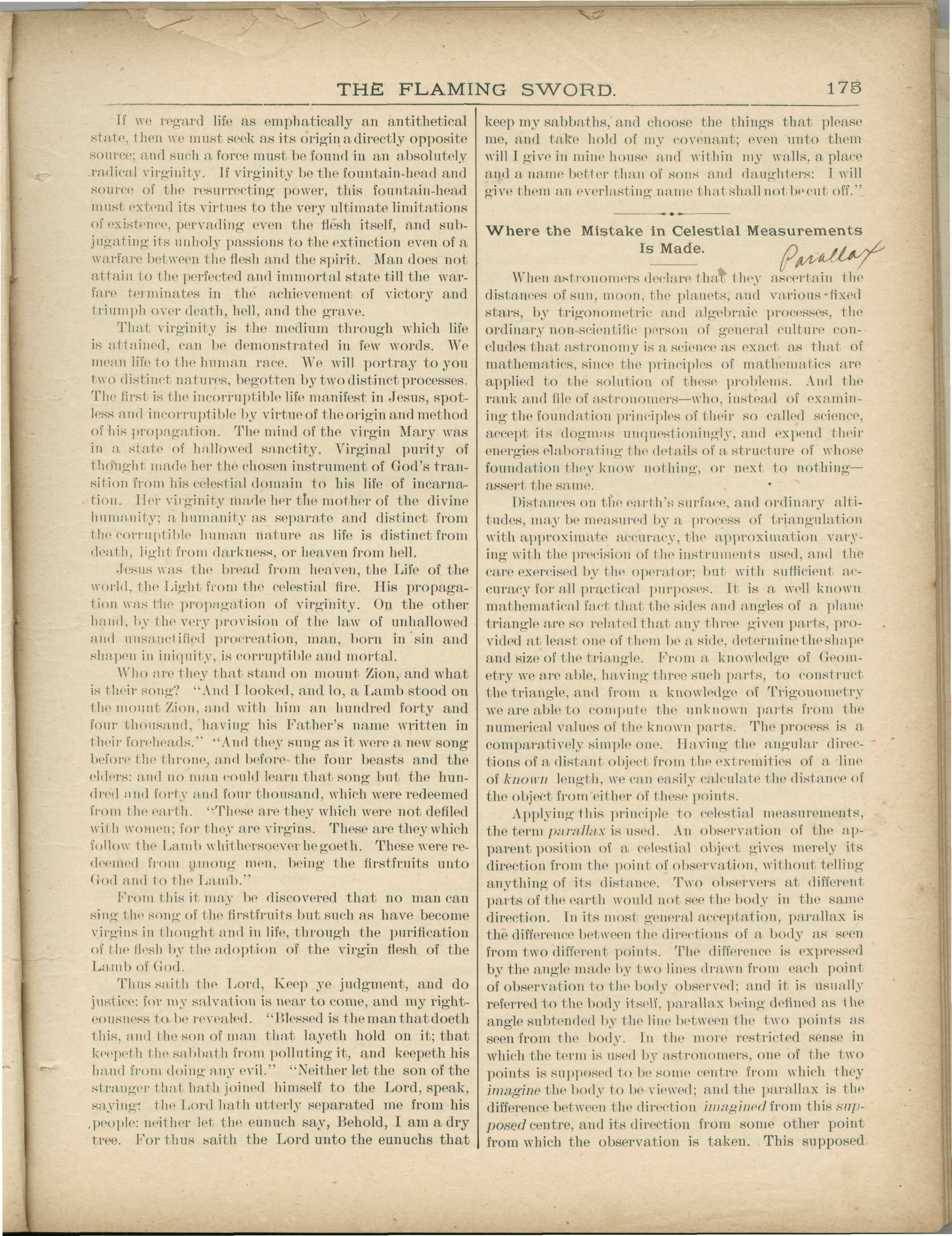
Applying this principle to celestial measurements, the term parallax is used. An observation of the apparent position of a celestial object gives merely its direction from the point of observation, without telling anything of its distance. Two observers at different parts of the earth would not see the body in the same direction. In its most general acceptance, parallax is the difference between the directions of a body as seen from two different points. The difference is expressed by the angle made by two lines drawn from each point of observation to the body observed; and it is usually referred to the body itself, parallax being defined as the angle subtended by the line between the two points as seen from the body. In the more restricted sense in which the term is used by astronomers, one of the two points is supposed to be some centre from which they imagine the body to be viewed; and the parallax is the difference between the direction imagined from this supposed centre, and its direction from some other point from which the observation is taken.
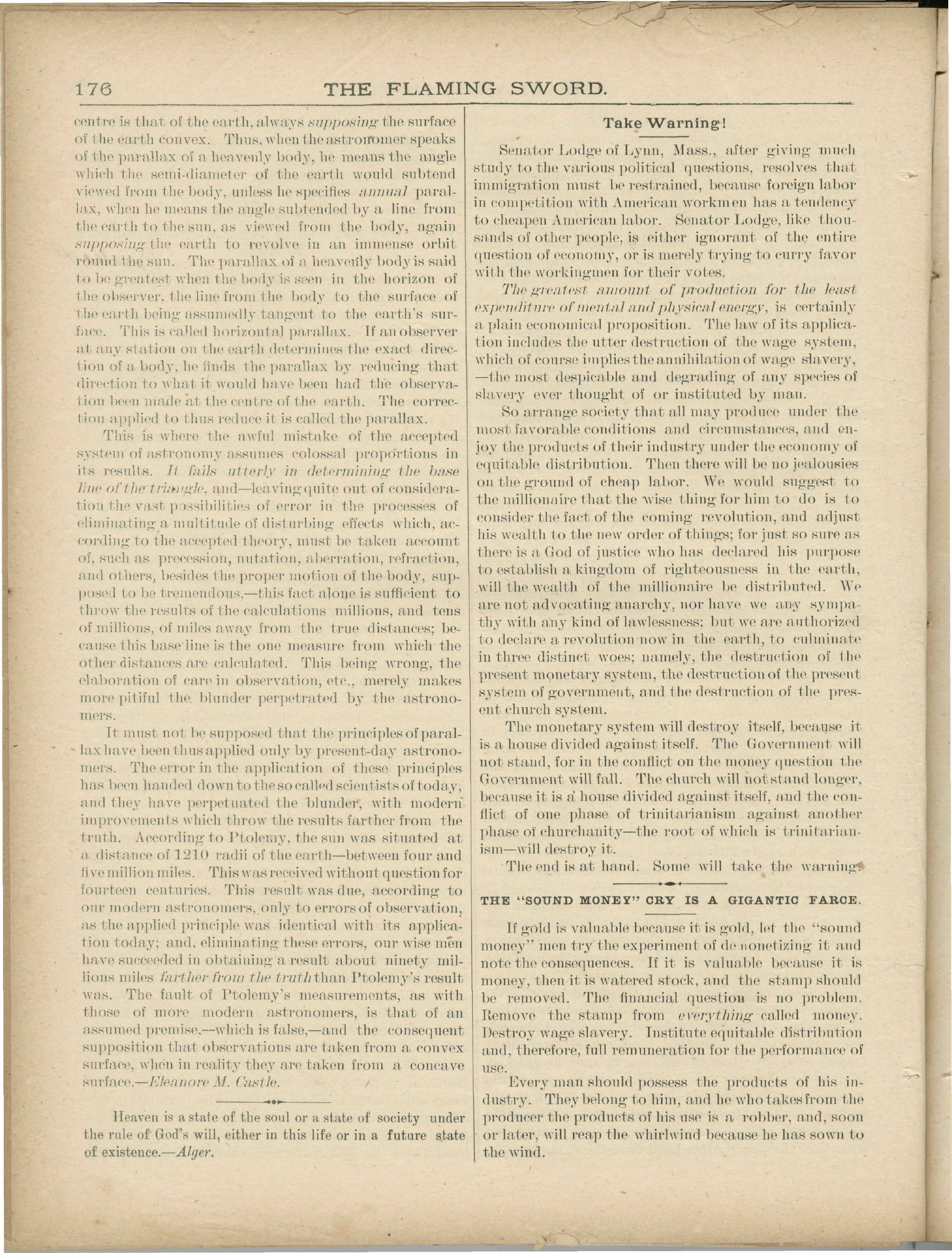
This supposed centre is that of the earth, always supposing the surface of the earth convex. Thus, when the astronomer speaks of the parallax of a heavenly body, he means the angle which the semi-diameter of the earth would subtend viewed from the body, unless he specifies annual parallax, when he means the angle subtended by a line from the earth to the sun, as viewed from the body, again supposing the earth to revolve in an immense orbit round the sun. The parallax of a heavenly body is said to be greatest when the body is seen in the horizon of the observer, the line from the body to the surface of the earth being assumedly tangent to the earth's surface. This is called horizontal parallax. If an observer at any station on the earth determines the exact direction of a body, he finds the parallax by reducing that direction to what it would have been had the observation been made at the centre of the earth. The correction applied to thus reduce it is called the parallax.
This is where the awful mistake of the accepted system of astronomy assumes colossal proportions in its results. It fails utterly in determining the base line of the triangle, and - leaving quite out of consideration the vast possibilities of error in the processes of eliminating a multitude of disturbing effects which, according to the accepted theory, must be taken account of, such as precession, nutation, aberration, refraction, and others, besides the proper motion of the body, supposed to be tremendous - this fact alone is sufficient to throw the results of the calculations millions, and tens of millions, of miles away from the true distances; because this base line is the one measure from which the other distances are calculated. This being wrong, the elaboration of care in observation, etc., merely makes more pitiful the blunder perpetrated by the astronomers.
It must not be supposed that the principles of parallax have been thus applied only by present-day astronomers. The error in the application of these principles has been handed down to the so-called scientists of today, and they have perpetuated the blunder, with modern improvements which throw the results farther from the truth. According to Ptolemy, the sun was situated at a distance of 1,210 radii of the earth - between four and five million miles. This was received without question for fourteen centuries. This result was due, according to our modern astronomers, only to errors of observation, as the applied principle was identical with its application today; and, eliminating these errors, our wise men have succeeded in obtaining a result about ninety millions miles farther from the truth than Ptolemy's result was. The fault of Ptolemy's measurements, as with those of more modern astronomers, is that of an assumed premise - which is false - and the consequent supposition that observations are taken from a convex surface, when in reality they are taken from a concave surface. - Eleanore M. Castle.
- --
The source scans remain the record. This page preserves the periodical's argument and reported observations without presenting its conclusions as independently established results. The claims remain attributed to The Flaming Sword.
← Flaming Sword Archive
The Flaming Sword · Vol. 9, No. 9 · · PDF pp. 3-4