Extracted text
Flaming Sword:—I wish to know if you can explain the ratio of convexity of the earth.’ * The curve is 333 1-3 miles to the thousand, or 5 miles for every 16 miles in extension, Do you teach that the earth is flat?
Dr. CARPENDER.
Chicago, Il.
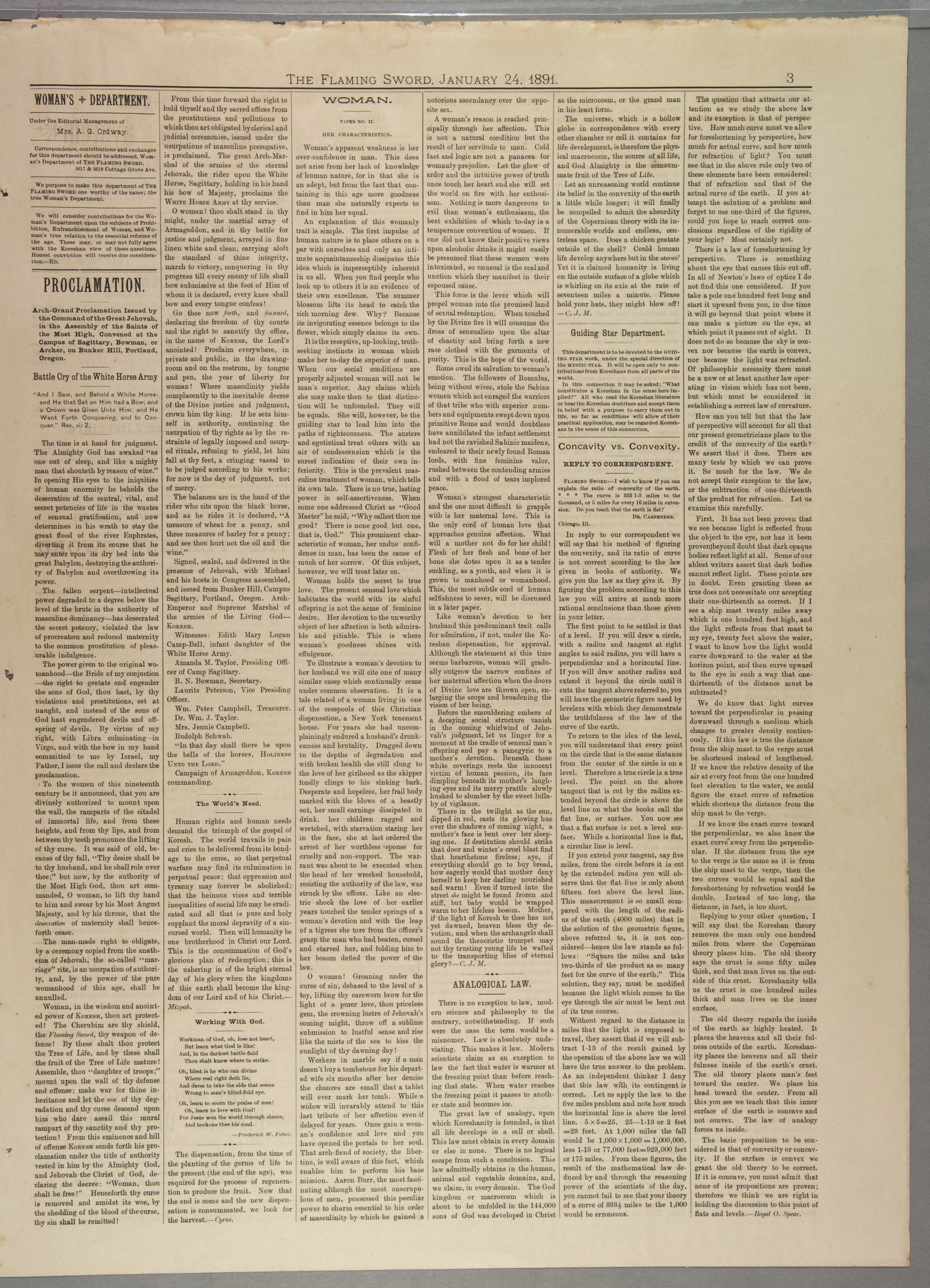
In reply to our correspondent we will say that his method of figuring the convexity, and its ratio of curve is not correct according to the law given in books of authority. We give you the law as they give it. By figuring the problem according to this law you will arrive at much more rational conclusions than those given in your letter.
The first point to be settled is that of a level. If you will draw a circle, with a radius and tangent at right angles to said radius, you will have a perpendicular and a horizontal line. If you will draw another radius and extend it beyond the circle until it cuts the tangent above referred to, you will have the geometric figure used by levelers with which they demonstrate the truthfulness of the law of the curve of the earth.
To return to the idea of the level, you will understand that every point on the circle that is the same distance from the center of the circle is on a level. Therefore a true circle is a true level. The point on the above tangent that is cut by the radius extended beyond the circle is above the level line on what the books call the flat line, or surface. You now see that a flat surface is not a level surface. While a horizontal line is flat, a circular line is level.
If you extend your tangent, say five miles, from the circle before it is cut by the extended radius you will observe that the flat line is only about fifteen feet above the level line. This measurement is so small compared with the length of the radius of the earth (4000 miles) that in the solution of the geometric figure, above referred to, it is not considered—hence the law stands as follows: “Square the miles and take two-thirds of the product as so many feet for the curve of the earth.” This solution, they say, must be modified because the light which comes to the eye through the air must be bent out of its true course.
Without regard to the distance in miles that the light is supposed to travel, they assert that if we will subtract 1-13 of the result gained by the operation of the above law we will have the true answer to the problem. As an independent thinker I deny that this law with its contingent is correct. Let us apply the law to the five miles problem and note how much the horizontal line is above the level line. 5×5=25. 25—1-13 or 2 feet =23 feet. At 1,000 miles the fall would be 1,000 x 1,000 = 1,000,000, less 1-13 or 77,000 feet=923,000 feet or 175 miles. From these figures, the result of the mathematical law deduced by and through the reasoning power of the scientists of the day, you cannot fail to see that your theory of a curve of 333⅓ miles to the 1,000 would be erroneous.
The question that attracts our attention as we study the above law and its exception is that of perspective. How much curve must we allow for foreshortening by perspective, how much for actual curve, and how much for refraction of light? You must see that in the above rule only two of these elements have been considered; that of refraction and that of the actual curve of the earth. If you attempt the solution of a problem and forget to use one-third of the figures, could you hope to reach correct conclusions regardless of the rigidity of your logic? Most certainly not.
There is a law of foreshortening by perspective. There is something about the eye that causes this cut off. In all of Newton's laws of optics I do not find this one considered. If you take a pole one hundred feet long and start it upward from you, in due time it will go beyond that point where it can make a picture on the eye, at which point it passes out of sight. It does not do so because the sky is convex nor because the earth is convex, nor because the light was refracted. Of philosophic necessity there must be a new or at least another law operating in vision which has not been, but which must be considered in establishing a correct law of curvature.
How can you tell but that the law of perspective will account for all that our present geometricians place to the credit of the convexity of the earth? We assert that it does. There are many tests by which we can prove it. So much for the law. We do not accept their exception to the law, or the subtraction of one-thirteenth of the product for refraction. Let us examine this carefully.
First. It has not been proven that we see because light is reflected from the object to the eye, nor has it been proven beyond doubt that dark opaque bodies reflect light at all. Some of our ablest writers assert that dark bodies cannot reflect light. These points are in doubt. Even granting these as true does not necessitate our accepting their one-thirteenth as correct. If I see a ship mast twenty miles away which is one hundred feet high, and the light reflects from that mast to my eye, twenty feet above the water, I want to know how the light would curve downward to the water at the horizon point, and then curve upward to the eye in such a way that onethirteenth of the distance must be subtracted ?
We do know that light curves toward the perpendicular in passing downward through a medium which changes to greater density continuously. If this law is true the distance from the ship mast to the verge must be shortened instead of lengthened. If we know the relative density of the air at every foot from the one hundred feet elevation to the water, we could figure the exact curve of refraction which shortens the distance from the ship mast to the verge.
If we know the exact curve toward the perpendicular, we also know the exact curve away from the perpendicular. If the distance from the eye to the verge is the same as it is from the ship mast to the verge, then the two curves would be equal and the foreshortening by refraction would be double. Instead of too long, the distance, in fact, is too short.
Replying to your other question, I will say that the Koreshan theory removes the man only one hundred miles from where the Copernican theory places him. The old theory says the crust is some fifty miles thick, and that man lives on the outside of this crust. Koreshanity tells us the crust is one hundred miles thick and man lives on the inner surface.
The old theory regards the inside of the earth as highly heated. It places the heavens and all their fulness outside of the earth. Koreshanity places the heavens and all their fulness inside of the earth’s crust. The old theory places man’s feet toward the center. We place his head toward the center. From all this you see we teach that this inner surface of the earth is concave and not convex. The law of analogy forces us inside.
The basic proposition to be considered is that of convexity or concavity. If the surface is convex we grant the old theory to be correct. If it is concave, you must admit that none of its propositions are proven; therefore we think we are right in holding the discussion to this point of flats and levels.— Royal O. Spear.
Editorial transcription checked against the cited scans; historical claims remain those of The Flaming Sword.
The Flaming Sword · Vol. 2, No. 8 · Jan 24, 1891 · PDF p. 3