The concave Earth model predicts that the less light bends due to changes in atmospheric temperature and pressure, the farther we can see objects near the surface of the Earth. Less upward refraction means greater visibility over distance, while more upward refraction means reduced visibility.
The conventional convex Earth model predicts the opposite relationship when observing objects that should be hidden beyond Earth’s geometric horizon. In order to see objects that would otherwise be obstructed by Earth’s convex curvature, atmospheric refraction must bend the light downward sufficiently to bring those objects into view. Without that downward refraction, the objects would remain hidden.
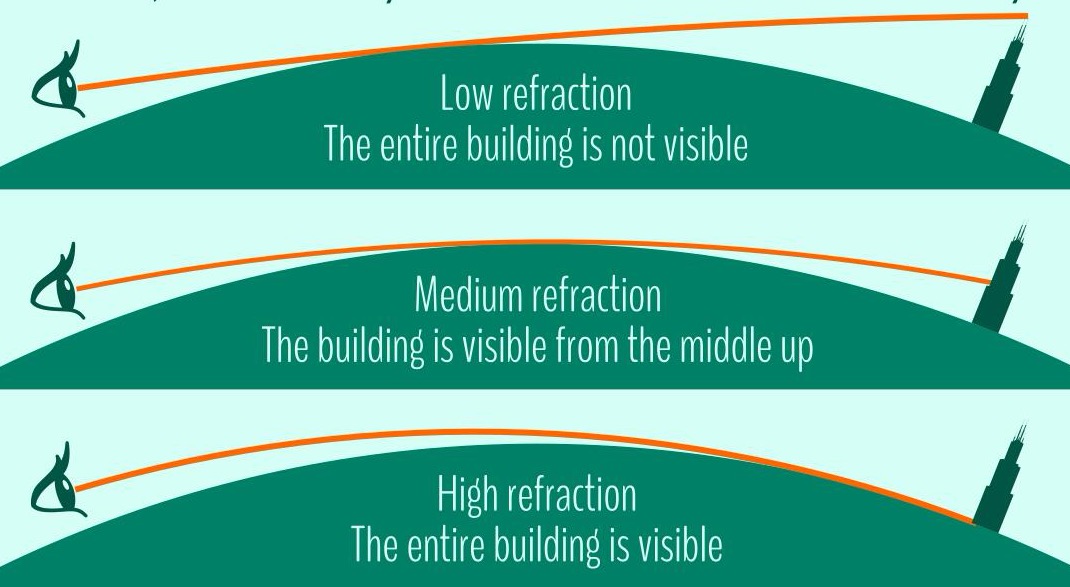
The convex Earth model therefore requires downward-bending light to explain observations of objects that should otherwise be geometrically obstructed.
The concave Earth model, by contrast, predicts that upward-bending light can obscure distant objects near the Earth’s surface. As this upward refraction decreases, more of those objects should become visible.
An inferior mirage is defined by light bending upward, while a superior mirage is defined by light bending downward.
Throughout my observations from locations around the world, I have only ever witnessed inferior mirages. In every instance where atmospheric conditions are clear enough to reveal a distinct, distant horizon, the inferior mirage appears precisely where the horizon is located.
My contention is that the horizon itself is an inferior mirage.
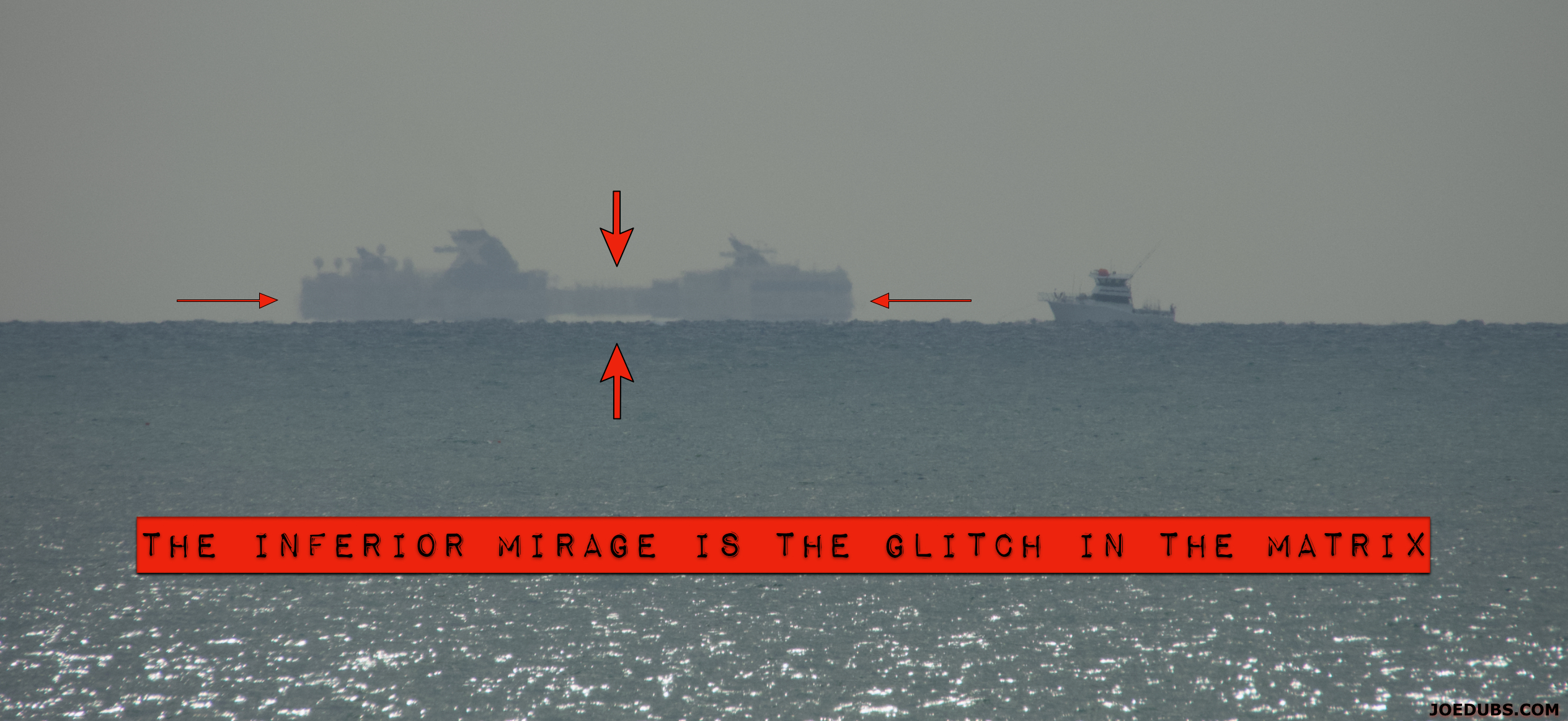
The term mirage is misleading because it suggests an unusual or occasional optical phenomenon. I propose that what we call an inferior mirage is actually a fundamental feature of how the horizon operates.
This phenomenon has nothing to do with water itself. Inferior mirages occur over land as well, particularly where temperature differences between the surface and the air above it cause light to bend upward. Water simply provides an expansive, relatively unobstructed surface that allows us to observe far enough into the distance for this optical boundary to become apparent. The same phenomenon can occur over land, but terrain, vegetation, buildings, and other obstructions often prevent us from seeing far enough to observe it as a continuous horizon.
To the naked eye, this phenomenon appears as a thin horizontal strip of sky where the atmosphere meets the distant surface. It is often nearly imperceptible, but this narrow region is where the optical effects become significant.
Light traveling toward the observer passes through a layer of atmospheric refraction, causing the rays to curve upward as they approach the eye. This produces the appearance of a thin strip of sky projected downward toward the surface.

Although the light rays bend upward through warmer, less dense air near the surface, the resulting image appears inverted and displaced downward. This happens because light from different parts of the object follows different curved paths toward the observer. The rays forming the inverted image arrive at the eye in a reversed angular order, creating the appearance of an upside-down reflection.
The eye interprets these incoming rays as traveling in straight lines, making the inverted image appear beneath the actual object, much like a reflection on the surface of a mirror. The apparent downward projection is therefore a consequence of upward-bending light, not evidence that the light itself is bending downward.
I call this phenomenon the Mirrizon, a term I coined by combining the words mirror and horizon.
The Mirrizon describes what I believe to be the true nature of the visible horizon: an optical boundary formed by atmospheric refraction, where upward-bending light produces a mirror-like inversion of distant objects and the sky.
Just as a mirror creates the appearance of an image extending beyond its physical surface, the Mirrizon creates the appearance of a boundary where the sky meets the distant surface. The inverted image is projected downward, concealing portions of distant objects and creating what we perceive as the horizon itself.
The lower portion of a distant boat, for example, disappears because it is obscured by this refractive layer, the very phenomenon we classify as an inferior mirage.
My argument is that the missing portion of the vessel is not being obstructed by Earth’s geometry, but by the behavior of light itself. In this interpretation, the Mirrizon is not a physical obstruction caused by Earth’s curvature, but an optical effect produced by the behavior of light in the atmosphere near the Earth’s surface.
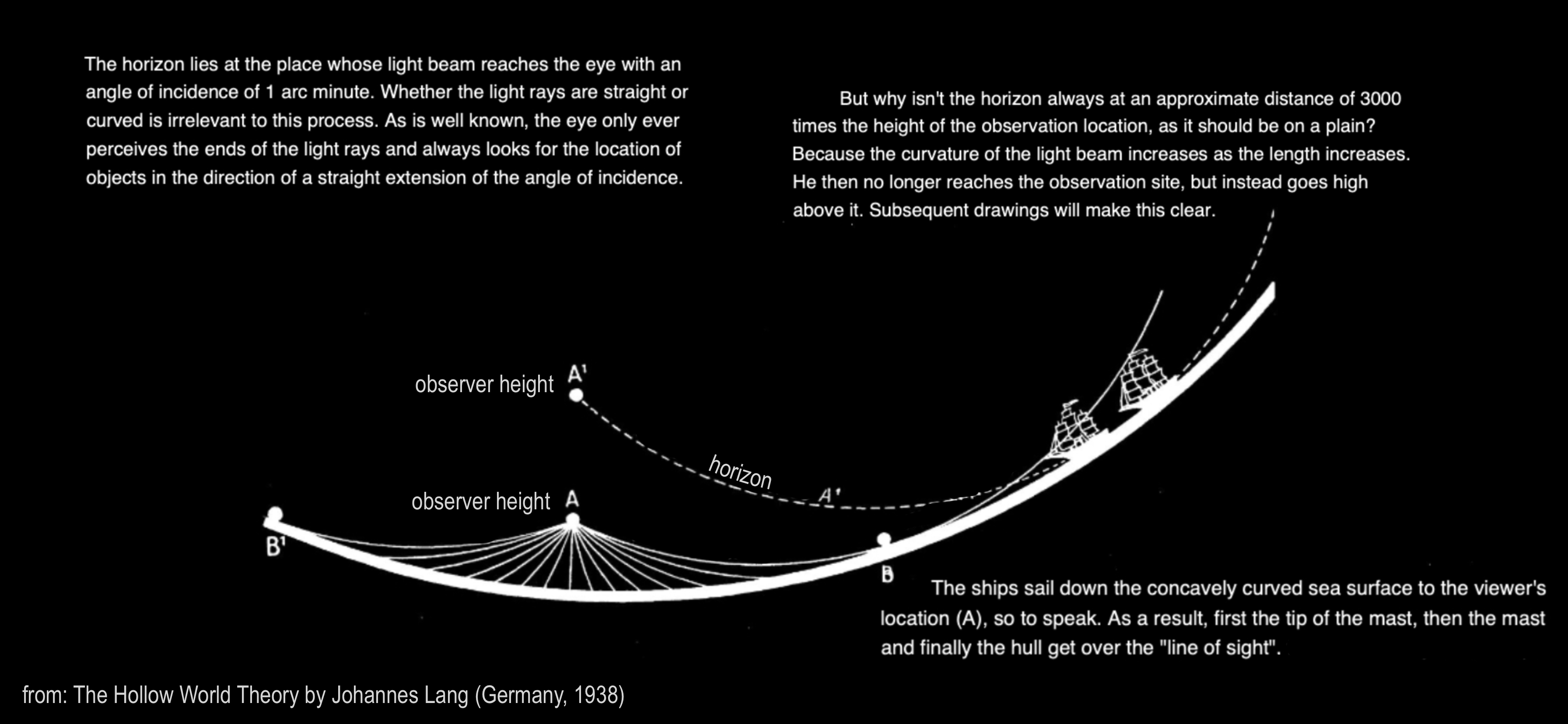
A Note on the Upward Path of Light
There's one important distinction I want to make regarding the cause of this upward refraction. I am not convinced that temperature gradients are necessarily responsible for the upward path of light itself. My suspicion is that light, and perhaps electromagnetic radiation in general, naturally follows an upward-curving trajectory, consistent with the upward curvature of the Earth’s surface in the concave Earth model.
In this interpretation, temperature, pressure, and other atmospheric conditions do not create that curvature, but instead modify, exaggerate, or distort an already existing path.
The horizon, therefore, is not the geometric construct it is commonly assumed to be, but an optical boundary created by the natural path of light itself.